
The Last Five Percent
Why the pain we never meet becomes the life we are forced to manage.

Yesterday morning, something cracked open in me as I watched twelve Epstein survivors speak publicly, some for the first time. Twelve women carrying decades of unspeakable harm stood at a podium and allowed the world to see what had lived inside them for far too long.
What struck me was not their trauma in the sensational sense. It was the burden of having to carry it alone for so many years while the world talked around them. The slow suffocation of living inside a story that kept their pain in the headlines but never brought them closer to being met. When they spoke about the years of mismanagement, something in my body softened. Not collapse. Not shattering. A widening. A quiet recognition of what it costs a person to hold what has never been met.
Their courage touched the place in me that remembers what it feels like to carry something unbearable with nowhere to put it.
I am a survivor of childhood sexual abuse. For most of my life, the memory was gone. My psyche locked it away so I could function, perform, achieve, and build. I always sensed something had happened, but I did not have the file. Then, four years ago, the memory returned with a force my system could not outrun. There was no preparation. No strategy. No control. It arrived, and everything in my life reoriented around it.
That moment set me on a path I could have never planned. It led me to a master’s degree in clinical psychology. It led me into a year of Compassionate Inquiry with Gabor Maté. It led me into Internal Family Systems and eventually into becoming an IFS therapist. But more importantly, it revealed something about my own internal world that I had never been able to name.
I began to understand what I had lived with for years, even as I helped others navigate their lives. The confusion. The relentless drive. The invisible weight. The moments of excellence are followed by the moments of confusion. What I had labeled self-sabotage was often the firefighting part of me stepping in to protect a younger part that was overwhelmed by what had never been met.
And in the process, I began to see a larger truth about the clients I work with. The founders, CEOs, creators, physicians, athletes, celebrities, and leaders who come with language for their wounds. Many have been in therapy for years. They can map their childhood, name their patterns, and speak fluently about the origins of their shame. More than once, I hear the familiar line: I have already worked on that. And they have. But insight does not dissolve what was never met. So they double down on optimization. They seek a new strategy. A new frame. A way to break through the stubborn five percent that keeps repeating. Yet the more profound truth is this: the part of them that will not shift is not resisting their awareness. It is resisting being managed by it.
What I have seen, in myself and in nearly thirty years of sitting with high performers, is that the outward success is real and earned, but the inner struggle is real too. The circumstances differ, but the emotional blueprint is the same. They are not suffering because they are weak. They are suffering because they were never taught how to meet what hurts.
And so they manage it. Beautifully. Strategically. Impressively. They curate lives. They build identities. They form polished personas that look like confidence but function like armor. They perform at extraordinary levels while carrying burdens that would break most people. And they confuse the burden for personality. They confuse the carrying for strength.
The trouble is that the strategies that built their lives are the same strategies that keep their pain intact. Managers stay ahead of the overwhelm. Firefighters quiet what cannot be controlled. Shame and fear fuel the entire dance while the part that most needs attention stays buried beneath the performance.
This is where the Last Five Percent lives in the space between what has been mastered and what has been avoided. By the Last Five Percent, I mean the part of us that remains untouched by all our insight, all our achievement, and all our strategies, the part that still carries what was never met.
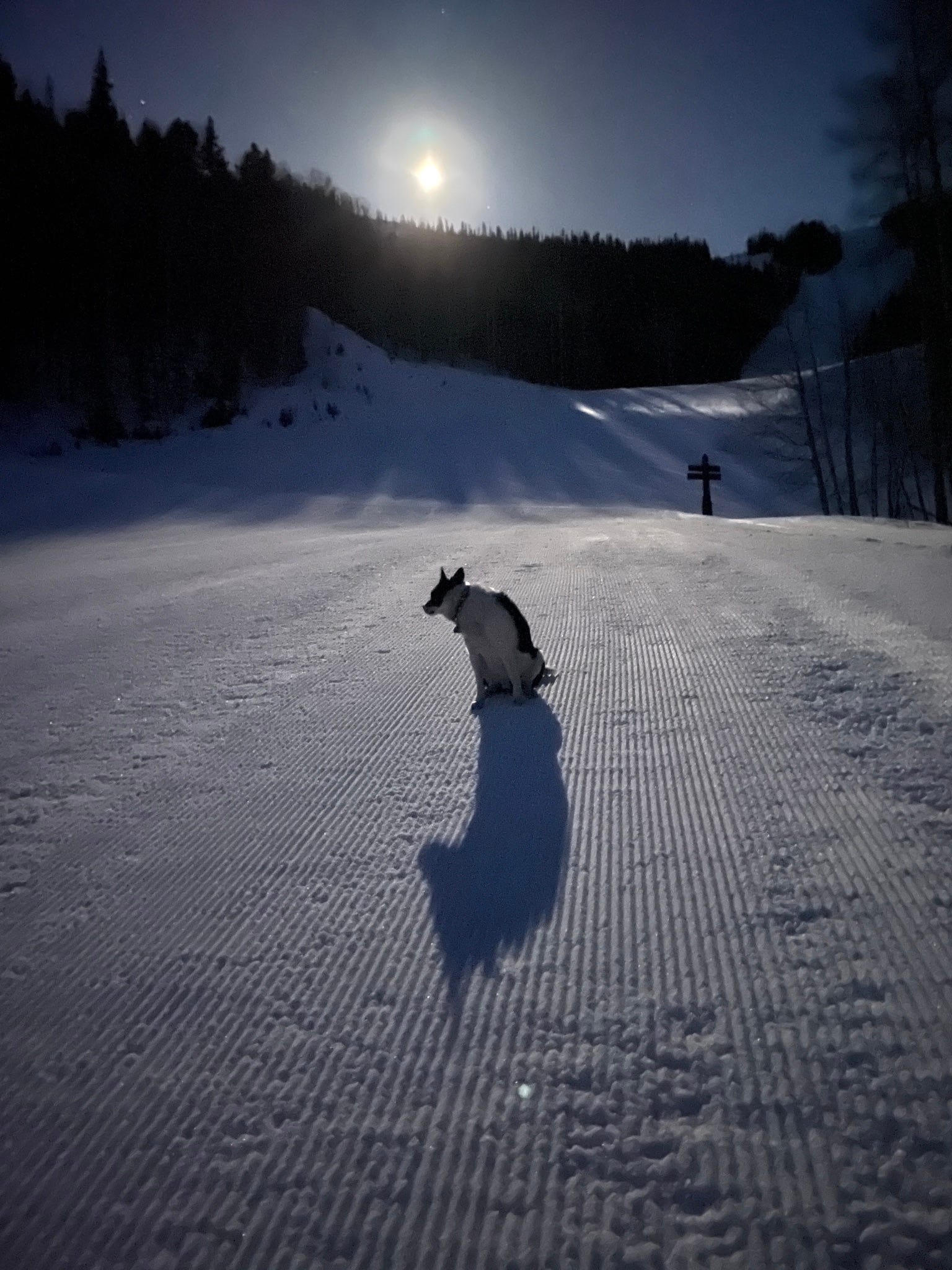
For me, the most recent doorway opened through Bear, my beloved companion. Ten days in the hospital. Ten days of uncertainty. Ten days of sitting beside him on the cold floor, watching blood numbers rise and fall, trying to interpret data that refused to give me any sense of control. And somewhere in those long nights, something I had kept at arm’s length surfaced with a clarity I could not negotiate.
It was not only the fear of losing him. It was the realization that he has been the most successful relationship of my life. The one place in my world where love did not depend on performance or identity or certainty. The one bond that never asked me to be more than I was. And the thought of losing that undid me in a way I did not expect.
There was another truth those nights uncovered, one I had quietly avoided for years. I saw how uneasy intimacy has been for me, not only in the romantic sense but in the deeper way it requires you to let yourself be affected by another being. Bear was the one presence in my life who loved me without condition or performance. Losing him meant losing the only place where I allowed myself to fully exhale.
And that realization broke through the story I had been telling myself for decades. I had worn my independence like a badge of honor, convincing myself that being alone meant I was strong, evolved, and self-sufficient. I said I liked my solitude. I said I preferred it. But beneath those lines lived a different truth. Some of my independence was real. Much of it was armor. A way to stay out of reach. A way to avoid the risk of letting someone close enough to matter. A way to manage the intimacy I quietly feared and quietly wanted.
I see this in others as clearly as I see it in myself. Single people who say they are content but feel unseen in the quiet moments. Couples who share a life yet still feel alone inside their own hearts. Breakups are dismissed as growth when they actually leave fractures that never get tended to. And in those nights with Bear, I finally saw that he had been part of my management system, too. His steady presence had protected me from realizing how much of my heart I kept sealed off. His crisis brought me face to face with the younger part of me who never stopped longing to feel safe, to feel held, to feel connected in a way my system had never fully trusted. The part that had been waiting for me to stop performing long enough to finally be met.
Most of us only discover these layers when something we love is put at risk.
These moments interrupt the architecture. They reveal the fragility of strategies that have carried us for decades. They ask us to see the truth beneath the truth. Not conceptually. Not philosophically. Somatically. Honestly. Without the filter of performance.
And this is where the turning begins. Because meeting what hurts is not an intellectual event. Awareness does not release it. Insight does not dissolve it. The brain cannot do the job the heart was meant to do.
At first, meeting the unmet part feels awkward. You are face-to-face with an emotional truth that has been trying to reach you for decades. You see that your most sophisticated strategies were designed to protect a much younger version of you. And when you finally meet that part with honesty and presence, the system recognizes that you are no longer five or seven or nine years old. The protective architecture begins to soften. The burden begins to lift.
This is not sentimentality. This is a physiological reorientation. A return to coherence between the body, the heart, and the mind. The managers no longer have to hold the whole system together. The firefighters can step back. And the younger part that has been carrying the fear is finally met instead of managed.
This is unburdening. Not a technique. Not a theory. A release. A softening of what has been held for far too long. A shift in the inner architecture that lets you inhabit your life rather than perform it. And the surprising truth is that this does not make you less powerful. It makes you more powerful.
More grounded.
More clear.
More embodied.
More capable of intimacy.
More able to lead without leaning on fear as fuel.
Because presence is not the absence of pain, presence is the ability to stay in relationship with what hurts without abandoning yourself.
This is the Last Five Percent. The part of us that refuses to be managed. The part that aches to be met. The part that carries the doorway home.
If you are in this place right now, I want to say something plainly. You are not failing. You are awakening.
And the part of you that quietly hurts the most underneath the powerful performance is not your weakness. It is the part that has been waiting to be seen.
I am walking this with you. You do not have to meet this part all at once. You only have to be willing to stop managing long enough to let it speak.
The reason this matters is simple. A life built on managing pain will always feel slightly out of reach.
This work is not about going backwards. It is about finally getting access to all of you. When the heart is no longer exiled from the mind, your intelligence starts working with you instead of on you. You stop needing pressure and self-criticism as fuel. You stop leading from urgency and start leading from clarity. Your capacity does not shrink when you unburden. It expands in ways that the managing mind could never imagine.
If you recognize yourself in these words, it is not an indictment. It is an invitation. You are not broken. You are not behind. You are someone whose strategies have been brilliant and expensive.
So ask yourself, honestly. Who would you be if you were no longer using your brilliance to manage pain? What would your life look like if the part of you still carrying the last five percent was finally met, held, and allowed to rest?
Thank you for continuing to walk this journey with me.
From the heart,
Shasheen
Thank you for taking the time to read this. Attention is one of the most valuable things we have, and I don’t take it lightly. These conversations matter because they name something so many of us feel but rarely speak aloud. If this resonated, I’d love to hear from you. Your comments help shape a community where we can be honest without performing. And if someone in your life might recognize themselves in these words, I hope you’ll share it with them. None of us are doing this alone.
I identify with this so much, and it really came into sharp focus yesterday watching the Epstein survivors. I cried for the young girls they were then, and the women they became. When I was that young girl, I wasn't able to meet what was happening to me -- but my coping strategies were incredibly effective. For many years I thought the fact that I was a productive person, an overachiever, meant I was healed! I literally mistook my performance for my authentic self. It took decades to finally find the tools -- and the courage -- to meet that part of me in an embodied way, and doing so has profoundly changed my life. I feel powerful in a way I never did in years past, because I now know I have my own back, that I'll never abandon myself again. Thank you for articulating this so beautifully.
Vulnerability…so beautiful and brave. I’ve always hated that word… sentiment, emotion, because it’s physically painful. I’ve learned first hand ignoring your heart can actually damage it. Now for me to heal I’m realizing the old pattern of
Bucking up, being strong and independent is not helping. I feel like the 5 yr old that doesn’t want to…. Do ANYTHING but doesn’t know how to do anything else. My heart ached while I cried reading this whole thread.
Your writing always touches me so deeply. ♥️ Thank you for sharing.